
On the Whale Coast, the Best Views Take the Longest to Sell
September 3, 2026
September 3, 2026
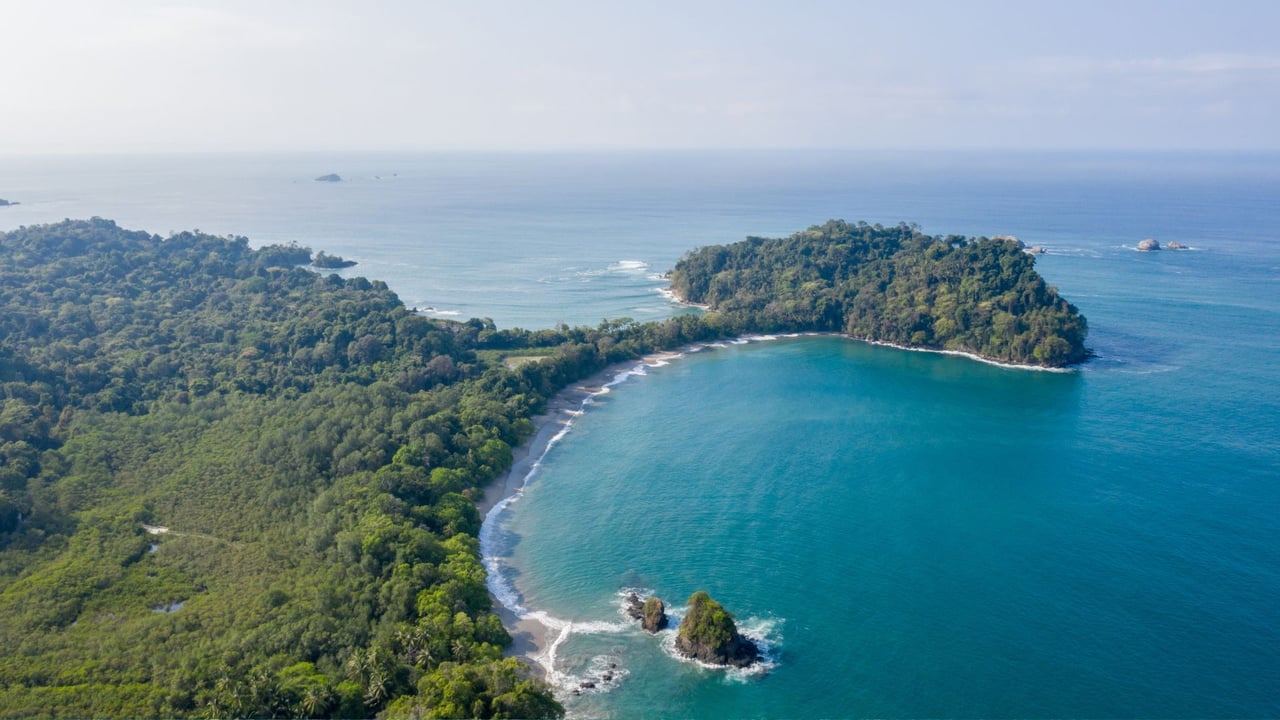
A home with a genuine Pacific view on Costa Rica's Costa Ballena took a median of 334 days to sell in the first half of 2026. A comparable home with no view at all sold in 282 days. That gap runs backward from what most buyers assume walking into this market, and it changes how you should think about pricing, timing, and where along this coast to actually look. Costa Ballena (the "Whale Coast") is a scenic 22-mile (35 km) stretch of the southern Pacific coastline in Costa Rica that runs from Dominical in the north down to Ojochal in the south.
The assumption is reasonable on its face. A view is the thing everyone wants, so it should be the thing that moves fastest. On the ground between Dominical, Uvita, and Ojochal, the opposite has been true this year. The feature that commands the highest price is also the one sitting longest on the market, and understanding why tells you more about how to buy or sell here than any median price you'll find on a listing site.
A local review of 108 reported sales from the first half of 2026 found that ocean-view homes did not sell faster than homes without one. Their median time on market ran to roughly 334 days, against about 282 days for houses lacking a view. The report is careful to note this isn't proof that a view subtracts value. Ocean-view homes in the sample tended to be larger, sit on more land, and cluster in established hillside communities where prices run higher across the board. What the data does show clearly is that view properties draw from a smaller, more selective pool of buyers, even when the feature itself is desirable and difficult to replicate.
That's the mechanism worth sitting with. A $1.2 million hillside estate with a full Pacific panorama isn't competing against every buyer who wants a home in Costa Ballena. It's competing against the handful who can and will spend at that level, and that pool doesn't refill as quickly as the market for a $350,000 two-bedroom near town. Higher price points generally have fewer qualified buyers everywhere, but the effect is sharper here because the ceiling on comparable inventory is thin and the buyers at that ceiling are patient by nature. They're not in a hurry, and neither is the seller who priced the home to reflect a scarce feature.
Part of why view homes carry such a premium in the first place traces back to a legal reality that shapes almost every transaction on this coast. Costa Rica's Maritime Zone Law sets aside a 200-meter public strip along every ocean beach. The first 50 meters from the high-tide line is fully public and cannot be titled to anyone. The next 150 meters is the concession zone, which can be leased from the municipality but never privately owned. Practically, this means true titled beachfront property is rare across the entire country, not just here. Most homes marketed as "beachfront" in Uvita, Dominical, or Ojochal are actually beach-access homes on titled land set back some distance from the shoreline.
That distinction matters for how ocean-view pricing works. Since actual titled beachfront is close to unavailable, an unobstructed hillside view becomes the closest thing to owning the ocean that a buyer can legally get. Sellers price accordingly, and the premium isn't unreasonable given the scarcity. But it also means the view home isn't really competing against beachfront inventory that barely exists. It's competing against every other elevated, panorama-grade property up and down a 35-kilometer stretch of coast, which widens the geography of comparison even as it narrows the buyer pool at that price level.
The clearest window into how this played out comes from closed-sale figures for 2025. Deals across Costa Ballena increased to 184 from 171 the year before, yet total closed volume actually fell, from $100.91 million in 2024 to $93.25 million in 2025. More transactions happened, but a larger share of them landed in the mid-market, while activity above roughly $500,000 slowed. Nearly half of all 2025 closings, 44.6 percent, involved at least one price reduction before the deal closed, and the properties that adjusted early in their listing life generally outperformed those that waited.
Read against the ocean-view data, this is the same story from a different angle. The buyer pool broadened at the middle of the market and thinned at the top, which is exactly where most true ocean-view properties sit. A seller anchored to a comparable sale from two or three years ago, before this shift, is often the one still waiting. As of a January 2026 accounting, active listings across the broader Costa Ballena region numbered around 907, representing close to $900 million in total inventory value, with vacant land alone accounting for more than 40 percent of that figure. Supply hasn't been the constraint. Matching realistic pricing to a smaller buyer pool has been.
There's a second force layered under all of this, and it has less to do with pricing than with geography. On a Costa Rica real estate podcast episode recorded in April 2026, the host laid out a pattern that Ben Rutherford, an associate broker who works Dominical, Uvita, Ojochal, and the newer community of Tres Ríos, confirmed from daily experience with clients: buyers who originally wanted Manuel Antonio moved to Dominical when Manuel Antonio filled in, then to Uvita once Dominical got busier, then to Ojochal, and now some are reaching Tres Ríos. The host summed it up plainly: people keep "rolling further south trying to find what they originally had."
That cascade explains an otherwise odd detail in the market data. A January 2026 market analysis found that Dominical carries a disproportionate share of high-end listing value relative to its number of properties for sale, which helps account for why absorption at the top of its market runs slower than in Uvita or Ojochal. Dominical was the first stop for buyers chasing jungle, cooler elevation, and a defined community, so its highest-end hillside inventory, much of it ocean-view, aged into the market before the next wave of demand arrived further south. Uvita, sitting in the middle of the coast along the fully paved Route 34, remains the most service-rich of the three towns and continues to see sustained demand across all price points into 2026. Budget guides current as of mid-2026 put Uvita's own range roughly like this: under $200,000 for modest homes and jungle lots, $200,000 to $400,000 for well-built two- and three-bedroom homes without full ocean exposure, $400,000 to $700,000 for quality three- and four-bedroom homes with real ocean views and pools, and $700,000 to $1.2 million for the panoramic estate tier where the longer selling timelines tend to concentrate.
Ojochal, 15 minutes further south and known locally for a dining scene shaped by French, Belgian, and Italian expats at spots like Exotica and Citrus, tends to draw buyers prioritizing privacy and quiet over proximity to services. Each town's character isn't incidental. It's the reason the same view premium behaves differently depending on which end of the coast you're standing on.
If you're selling a view property here, the lesson from 2025 is not to panic at a slow start. It's to price from current comparable data rather than a memory of what similar homes fetched during the faster post-pandemic years, and to treat an early price adjustment as a strategy rather than a concession. The report tracking 2025 closings found that timing mattered more than the size of the first cut. Sellers who moved early kept more leverage than those who waited for the market to come back to their number.
If you're buying, the same data works in your favor. A longer median time on market for view properties means more room to negotiate on homes that have been listed for a while, provided the underlying reasons for value, elevation, privacy, access, and construction quality still hold. It also means the search shouldn't stop at one town. Given how buyers cascade down this coast looking for a version of what the last town used to offer, comparing Dominical, Uvita, and Ojochal against each other, rather than falling in love with one, is where the real advantage sits.
Does a longer time on market mean a view home is overpriced? Not necessarily. It often reflects a smaller buyer pool at that price point rather than a flaw in the property. It does mean sellers and buyers should expect a longer runway and negotiate with that timeline in mind.
Is there any way to get titled land directly on the beach in Costa Ballena? It's rare. The Maritime Zone Law keeps the first 50 meters from the high-tide line fully public and the next 150 meters available only through a non-ownable municipal concession. Most homes described as beachfront are titled properties a short distance inland with beach access.
Should a buyer limit the search to just one town? Given how demand rolls from Dominical to Uvita to Ojochal and now toward Tres Ríos as each fills in, comparing all of them against your actual priorities, services, elevation, privacy, dining, tends to surface better value than committing to one town first.
Costa Ballena rewards patience on both sides of a transaction, and the data from this year backs that up more clearly than any single listing photo can. If you're weighing a purchase or a sale along this stretch of coast and want the pricing and timing context specific to your property or your search, Luxury Living Costa Rica can walk through what the current numbers mean for your situation. Get started now.
This article is general information, not legal, tax or financial advice. Consult a qualified professional about your situation.
Stay up to date on the latest real estate trends.


Jaco Beach Costa Rica - A beach community lifestyle
Invest in a lifestyle that values community, nature, and authentic Costa Rican culture. Contact us today to get started!
LUXURY LIVING COSTA RICA
PLAZA TEMPO ESCAZÚ SAN JOSÉ SAN RAFAEL COSTA RICA 10903